Showing posts with label osprey. Show all posts

Monday, February 17, 2020

Ragnarok: The Abyss & more upcoming releases from Osprey!

Order by Date: February 20, 2020
Street Date: March 24, 2020

OSPMOR003
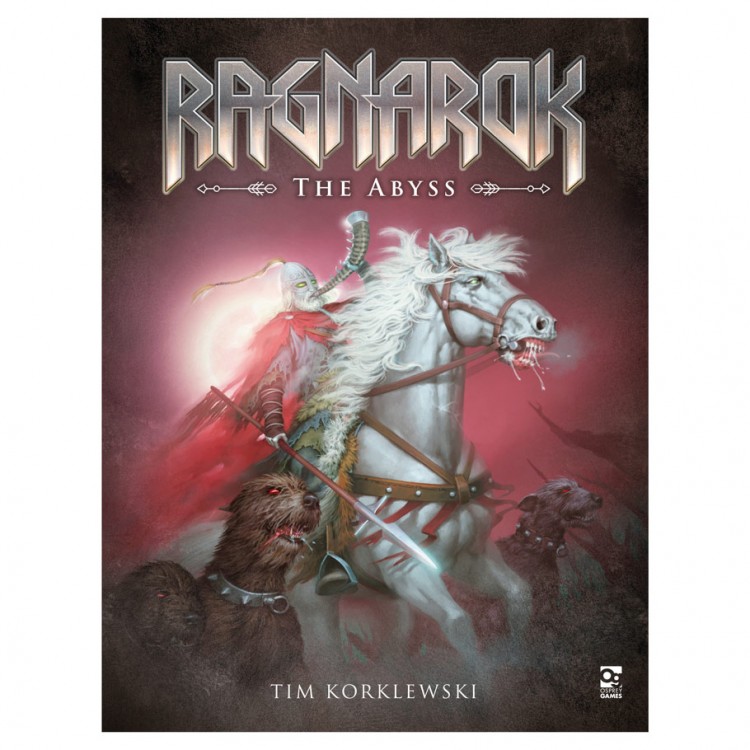
Ragnarok: The Abyss

$30.00 SRP
SDI

A supplement introducing the horrors of the Gaping Abyss to Ragnarok, the game of vicious Viking combat with a heavy metal edge.

Ginnungagap, the Gaping Abyss, was once what separated the realms of Ice and Fire, keeping them in balance and sparing the other realms from their ravages. With the Nine Realms shattered, however, Ginnungagap has been left unguarded and unspeakable horrors now await those who wish to cross it.

Ragnarok: The Abyss includes new scenarios for Ragnarok as well as new monsters to vanquish in glorious battle. New mechanics introduce something once barely recognized by war clans--Fear--and present entirely new challenges for them to overcome in the telling of their sagas.

Author: Tim Korklewski
Illustrator: RU-MOR
112 page hardcover


OSPCAM347
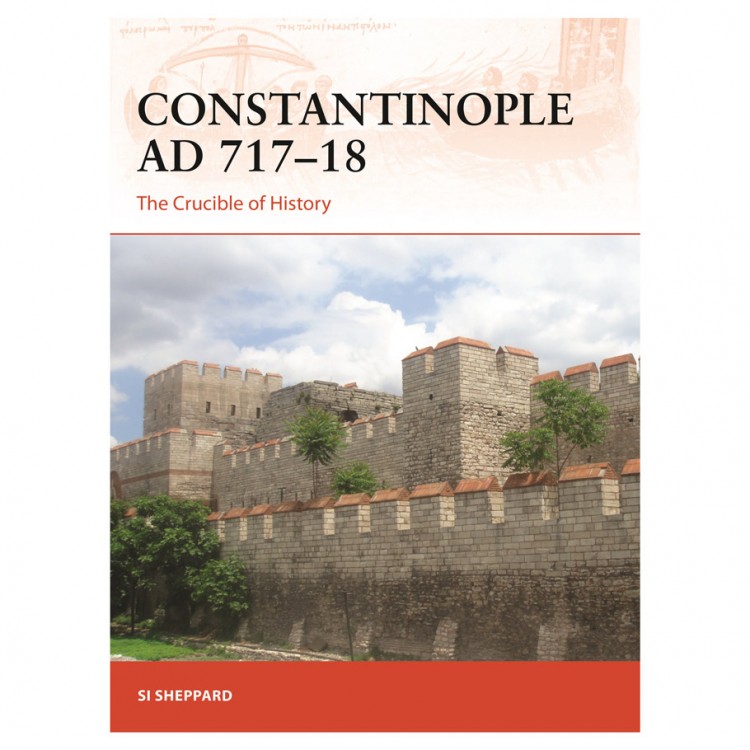
Constantinople AD 717–18

$24.00 SRP
SDI

The siege of Constantinople in AD 717--18 was a key clash between the expanding Umayyad Caliphate and the Byzantine Empire, and one which influenced the fate of Western civilization. In this specially illustrated study, Si Sheppard examines the course of this pivotal campaign.

The siege of Constantinople in AD 717--18 was the supreme crisis of Western civilization. The Byzantine Empire had been reeling under the onslaught of Arabic imperialism since the death of the Prophet, whilst Jihadist armies had detached Syria, Palestine, Egypt, and Carthage from imperial control and were in the process of imposing their ascendancy at sea. The Empire had been reduced to its Anatolian and Balkan heartland, and Arab incursions threatened even this--Arab naval forces had appeared under the walls of Constantinople every year from 674 to 678. But all this was only a prelude to the massive combined-arms invasion force that advanced on the capital in 717.

This title offers a comprehensive study of the ensuing clash between the ascendant Caliphate and the Empire at bay. It details the forces available to each side, with their respective advantages and vulnerabilities, evaluating the leadership qualities of the rival commanders and assessing their strategic and tactical initiatives. It also accounts for the trajectory and outcome of the campaign and emphasizes the fundamental significance of the struggle. By holding the line, the Byzantines gave Europe enough time to develop at its own pace and emerge strong enough to face down its Islamic counterpart on equal terms. If Constantinople had fallen in 717, could Europe have endured as an independent entity? Could Christianity have survived as major religion? What would the future course of world history have been?

Author: Si Sheppard
Illustrator: Graham Turner
Softcover

OSPCBT047
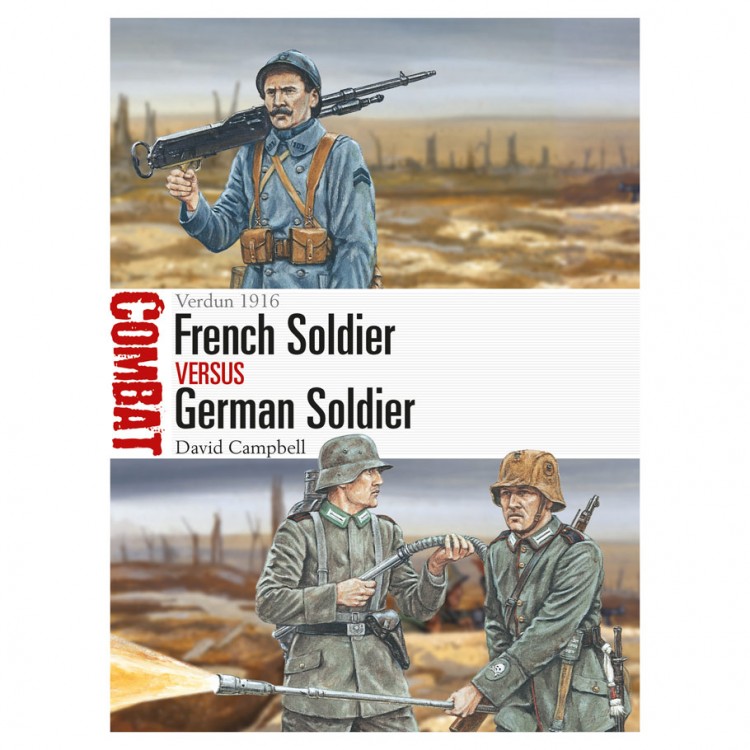
French Soldier vs German Soldier

$22.00 SRP
SDI

Featuring specially commissioned artwork, archive photography, and full-color maps, this engrossing study investigates the doctrine, training, equipment, and combat record of the French and German troops who clashed in three key battles during the epic struggle for the Verdun sector at the height of World War I.

On February 21, 1916, the German Army launched a major attack on the French fortress of Verdun. The Germans were confident that the ensuing battle would compel France to expend its strategic reserves in a savage attritional battle, thereby wearing down Allied fighting power on the Western Front. However, initial German success in capturing a key early objective, Fort Douaumont, was swiftly stemmed by the French defenses, despite heavy French casualties. The Germans then switched objectives, but made slow progress towards their goals; by July, the battle had become a stalemate.

During the protracted struggle for Verdun, the two sides’ infantrymen faced appalling battlefield conditions; their training, equipment, and doctrine would be tested to the limit and beyond. New technologies, including flamethrowers, hand grenades, trench mortars, and more mobile machine guns, would play a key role in the hands of infantry specialists thrown into the developing battle, and innovations in combat communications were employed to overcome the confusion of the battlefield. This study outlines the two sides’ wider approach to the evolving battle, before assessing the preparations and combat record of the French and German fighting men who fought one another during three pivotal moments of the 10½-month struggle for Verdun.

Author: David Campbell
Illustrator: Adam Hook
Softcover

OSPMAA530
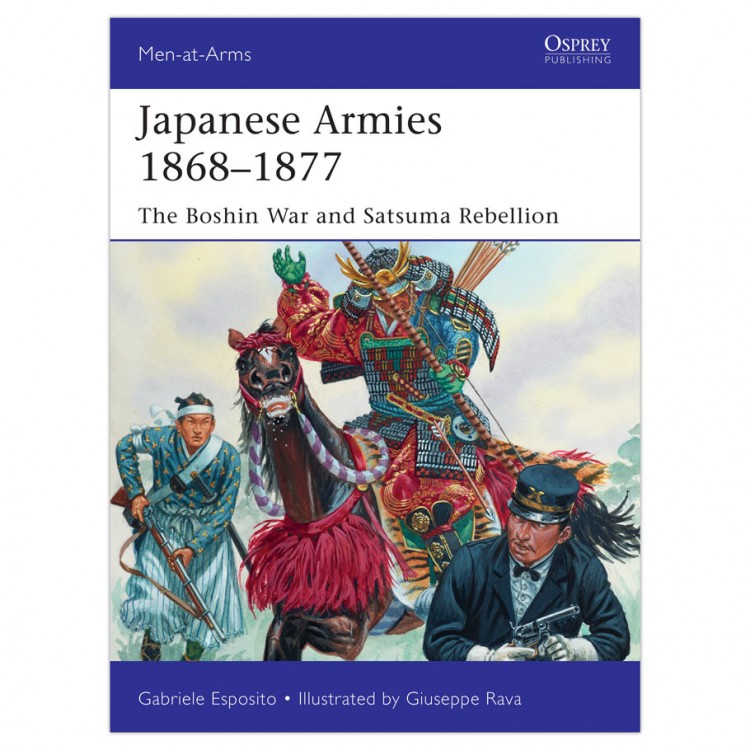
Japanese Armies 1868–1877

$19.00 SRP
SDI

This title explains and illustrates the 19th-century transition of Japanese armies from traditional Samurai equipment and tactics to those of the Western world, and the armed clashes between the two cultures.

The restoration of the Meiji Imperial dynasty in 1868, after 250 years of the Tokugawa Shogunate, decisively opened Japan to the outside world and the monarchy embraced modernization, including the creation of a new Westernized army. However, this modernization process was resisted by the traditional Samurai feudal nobility, leading to a series of battles.

The first clash between the two cultures came swiftly. During the Boshin War of 1868¬--69, a French military adviser, Jules Brunet, changed sides to join the insurgents. They won several engagements before the final crushing of the rebel Ezo Republic. After this point, the Imperial Army continued to modernize along French lines, and social changes began to impoverish Samurai noblemen, who lost their social and political role and their associated privileges.

During 1876, the powerful Satsuma Domain, around Kagoshima in southwest Kyushu, became a focus for discontent. Its leader Saigo Takamori effectively ignored the central government, and in January 1877, increasing unrest broke out into open rebellion. The Imperial forces were now much stronger, and the Navy could land troops and bombard Kagoshima. The bitter Satsuma siege and attempted capture of Kumamoto Castle finally failed in April, and the Samurai made a last stand at Shiroyama on September 24, choosing to go down fighting. This marked the final defeat and displacement of the Samurai class.

This fully illustrated title explores the fall of the Samurai in detail, examining the arms, tactics, key figures of both sides, and charting the increasing Westernization of the Imperial forces.

Author: Gabriele Esposito
Illustrator Giuseppe Rava
Softcover

OSPNVG280
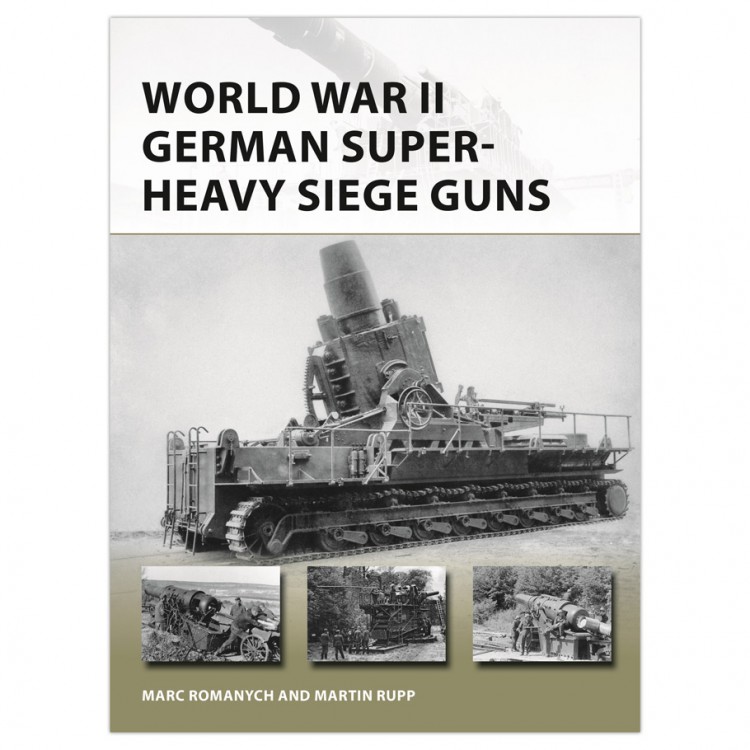
World War II German Super-Heavy Siege Guns

$19.00 SRP
SDI

This is a new history of Germany's powerful super-heavy siege artillery of World War II, which were designed to smash the most formidable fortresses on the Western and Eastern fronts.

As the outbreak of World War II approached, Nazi Germany ordered artillery manufacturers Krupp and Rheimetall-Borsig to build several super-heavy siege guns, vital to smash through French and Belgian fortresses that stood in the way of the Blitzkrieg. These "secret weapons" were much larger than the siege artillery of World War I and included the largest artillery piece of the war, the massive 80cm railway gun "schwere Gustav" (Heavy Gustav). However, these complex and massive artillery pieces required years to build and test and, as war drew near, the German High Command hastily brought several WWI-era heavy artillery pieces back into service and then purchased, and later confiscated, a large number of Czech Skoda mortars.

The new super siege guns began entering service in time for the invasion of Russia, notably participating in the attack on the fortress of Brest-Litovsk. The highpoint for the siege artillery was the siege of Sevastopol in the summer of 1942, which was the largest concentration of siege guns in the war. Afterwards, when Germany was on the defensive in the second half of 1943, the utility of the guns was greatly diminished, and they were employed in a piecemeal and sporadic fashion on both the Eastern and Western Fronts. In total, the German Army used some 50 siege guns during World War II, far more than the thirty-five it had during World War I.

Supported by contemporary photographs and detailed artwork of the guns and their components, this is an essential guide to these guns, exploring their history, development, and deployment in stunning detail.

Authors: Marc Romanych and Martin Rupp
Illustrator: Andrea Ricciardi di Gaudesi
Softcover

OSPRAD052
Operation Eagle Claw 1980

$22.00 SRP
SDI

A fully illustrated history of the disastrous 1980 attempt to rescue the 53 US Embassy hostages in Tehran, which involved the new Delta Force and a complex series of airlifts, hides and refueling stops in the Iranian desert.

Following months of negotiations after the seizure of the US Embassy in Tehran on November 4 1979, President Jimmy Carter ordered the newly formed Delta Force to conduct a raid into Iran to free the hostages. The raid, Operation Eagle Claw, was risky to say the least. US forces would have to fly into the deserts of Iran on C-130s; marry up with carrier-based RH-53D helicopters; fly to hide sites near Tehran; approach the Embassy via trucks; seize the Embassy and rescue the hostages; board the helicopters descending on Tehran; fly to an airbase captured by more US forces; and then fly out on C-141s and to freedom. Unfortunately, and unsurprisingly given the complexity of the mission, things went wrong from the start and when the mission was called off at the refueling site at Desert One, the resulting collision between aircraft killed eight US personnel.

This title tells the full story of this tragic operation, supported by maps, photographs, and specially-commissioned bird’s-eye-views and battlescenes, which reveal the complexity and scale of the proposed rescue and the disaster which followed.

Author: Justin Williamson
Illustrators: Jim Laurier and Johnny Shumate
Softcover

Saturday, January 11, 2020

Oathmark, Letterpress & more from Osprey!

Order by Date: January 18, 2020
Release Date: March 2020


OSPOAK001
Oathmark

$35.00 SRP
SDI

A mass-battle fantasy game in which players can field combined armies of humans, elves, goblins, dwarves, and more, and develop that army over the course of a campaign.

Empires have fallen, and the land is broken. The great oathmarks that once stood as testaments to the allegiances and might of nations have crumbled into ruin. In this lost age, fealty and loyalty are as valuable as gold and as deadly as cold iron, and war is ever-present.

Created by Joseph A. McCullough, designer of Frostgrave and Frostgrave: Ghost Archipelago, Oathmark is a mass-battle fantasy wargame that puts you in command of the fantasy army you’ve always wanted, whether a company of stalwart dwarves or a mixed force with proud elves, noble men and wild goblins standing shoulder-to-shoulder in the battle-line. Fight through an integrated campaign system and develop your realms from battle to battle, adding new territories, recruiting new troop types and growing to eclipse your rivals… or lose what you fought so hard to gain and fall as so many would-be emperors before you.


Order by Date: January 20, 2020
Release Date: February 2020
________________________________________________________

OSPGAM033
Letterpress

$21.00 SRP
SDI

Johannes Gutenberg has given us letterpress printing, but it's up to you to master it!

Compete with your rival wordsmiths to craft the most impressive words and win first pick of letters to add to your collection. Choose wisely, for you will find any you leave in the words of your opponents, and the player who uses their stored letters to greatest effect will spell victory.

Playable by up to six players, with solitaire rules pitting you against the industrious rotary printer, Letterpress offers an enticing challenge sure to appeal to gamers and word-lovers alike.

1-6 players
Ages 14+
20 minute play time

Contents:
  • 110 cards

Order by Date: January 20, 2020
Street Date: February 18, 2020
________________________________________________________

OSPACM015
Battle of the Atlantic 1939–41

$24.00 SRP
SDI

In his six-volume series The Second World War, Winston Churchill wrote 'The only thing that ever really frightened me during the war was the U-boat peril.' Initially, however, everyone was surprised at the effectiveness of the submarines. Sonar proved less efficient a detection method than the British had predicted; surface attack made the U-boat invisible, especially at night; and wolf-pack tactics overwhelmed convoy escorts. Only faulty German torpedoes and the restricted number of available U-boats limited their success.

Astonishingly, Britain had the major piece of the solution to the U-Boat threat from the opening days of World War II: the anti-submarine aircraft. If it had been used assiduously and effectively in the first months of the war, Britain might have won the Battle of the Atlantic in its first year. Instead, the opportunity was missed and the Battle of the Atlantic continued until Germany's surrender in May 1945.

This title examines the role played by aircraft in the early years of the Battle of the Atlantic. Highlighting their success when employed effectively, the book follows these early operations to show how and why aircraft were initially misused. It also traces the development of technologies which made aircraft much more effective submarine-killers including radar and depth charges.

Author: Mark Lardas
Illustrator: Edouard A Groult
Softcover


OSPCAM346
Yalu River 1950–51

$24.00 SRP
SDI

Following the Inchon landings and the breakout from the Pusan Perimeter, UN forces crossed the North Korean border on 9 October and moved on the capital Pyongyang. Many in America believed the war would be over by Christmas, but some Washington diplomatic, military, and intelligence experts continued to raise dire warnings that the People's Republic of China might intervene. Nevertheless, General MacArthur decided to push on to the Chinese/North Korean border, the Yalu River. On 25 October, Communist Chinese Forces unexpectedly attacked Republic of Korea forces near Unsan. Then, on 25 November, the day after MacArthur announced a ‘final offensive to end the war', the Chinese 13th Army Group struck in mass against the Eighth Army in the north-west corner of North Korea, overrunning the US 2nd and 25th Infantry Divisions.

The Chinese attacks quickly shattered Truman's dream of a unified Korea. American, UN, and ROK forces could not hold a successful defensive line against the combined CCF and NKPA attacks. At the Chosin Reservoir, US Marine Corps and Army units retreated south whilst MacArthur's forces withdrew from Pyongyang and X Corps later pulled out of Hungnam.

Using expert research, bird's-eye views, and full-colour maps, this study tells the fascinating history of the critical Yalu campaign, including the famous retreat past the 38th Parallel.

Author: Clayton K. S. Chun
Illustrator: Johnny Shumate
Softcover


OSPCBT046
British Rifleman vs French Skirmisher

$24.00 SRP
SDI

The battles between British and French forces during the Peninsular War (1807-14) and the Hundred Days campaign of 1815 saw both sides deploy specialist units of skirmishers trained in marksmanship and open-order combat. These ‘light' troops fulfilled several important roles on the battlefield, such as ‘masking' large bodies of close-order troops as they manoeuvred in battle, firing upon enemy troops to provoke them into attacking prematurely, and harassing enemy artillery crews and senior officers with aimed fire. On occasion, the skirmishers were tasked with special missions requiring individual initiative, such as the capture or defence of key battlefield positions, especially those situated in difficult terrain.

While Napoleon's skirmishers carried the smoothbore musket, notoriously inaccurate and short-ranged, several elite units fighting for Britain were armed with the rifle, a far more accurate weapon that was hampered by a slower rate of fire. As well as the legendary 95th Rifles, Britain fielded rifle-armed German troops of the 60th Regiment and the King's German Legion, while France's light troops were fielded in individual companies but also entire regiments. In this study, David Greentree assesses the role and effectiveness of rifle-armed British troops and their French open-order opponents in three very different encounters: Roliça (August 1808), the first British battle of the Peninsular War; the struggle for a key bridge at Barba del Puerco (March 1810); and the bitter fight for the La Haye Sainte farmhouse during the battle of Waterloo (June 1815).

Author: David Greentree
Illustrator: Adam Hook
80 page softcover

More February Releases from Osprey
ItemDescriptionSRPPricing
OSPELI231Soviet Airborne Forces 1930–91$20.00SDI
OSPELI232World War II US Fast Carrier Task Force Tactics 1943–45$20.00SDI
OSPGNM398The Master Shipwright's Secrets Behind a Restoration Warship$80.00SDI
OSPGNM405Sisters in Arms$24.00SDI
OSPGNM407In Good Faith$35.00SDI
OSPGNM408Flying Tiger Ace$35.00SDI
OSPGNM409Hitler's Tanks$40.00SDI
OSPNVG278US Navy Cold War Guided Missile Cruisers$19.00SDI
OSPNVG279American Privateers of the Revolutionary War$19.00SDI